

How to Design a Multi-Tenant SaaS Architecture: Isolation, Scaling and Cost
How to design a multi-tenant SaaS architecture: choose a tenancy model, isolate tenant data, prevent noisy neighbors, and scale from a modular monolith MVP.
- Author
- Swagat Murmu
- Published
- Reading time
- 14 min
- Category
- SaaS
How Do You Design a Multi-Tenant SaaS Architecture?#
Start with a modular monolith, one shared database, and a tenant_id on every table that holds customer data. It's the setup I'd pick for almost any first SaaS product: cheap to build, easy to test, simple to deploy, and it leaves room to tighten isolation later.
Good multi-tenant SaaS architecture design rests on three layers: data isolation, authentication, and request context. Get those right and the rest is mostly plumbing. Get them wrong and one customer eventually sees another customer's data.
Seven decisions carry most of the weight:
- Users. One global account per person, no matter how many companies they work with.
- Tenants. Every organization or personal workspace is a tenant.
- Memberships. A join table that links users to tenants with a role such as
OWNER,ADMIN,MEMBER, orVIEWER. - Data isolation. Put
tenant_idon every tenant-owned table: contacts, leads, tasks, notes. - Authorization. On every request, confirm the user belongs to the requested tenant and has permission for the action.
- Query scoping. Always filter by tenant and record ID. Never fetch tenant data by record ID alone.
- Cross-tenant tests. Prove that a user in Tenant A can't read, update, or delete anything in Tenant B.
Here's how the data hangs together:
users
  └── memberships ── tenants
                         │
                         ├── contacts (tenant_id)
                         ├── leads    (tenant_id)
                         ├── tasks    (tenant_id)
                         └── notes    (tenant_id)
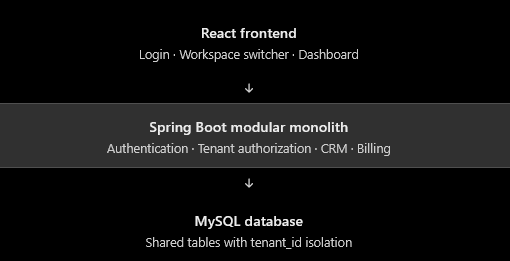
For an MVP, I'd run React (Vite) or Next.js on the frontend, Spring Boot with Spring Security and Spring Data JPA on the backend, and a managed PostgreSQL database. One app. One database. Add microservices or separate databases only when real scaling, security, or operational needs justify the extra work.
What Is Multi-Tenant SaaS Architecture?#
Multi-tenant SaaS architecture is a design where one application serves many customers, called tenants, while keeping each customer's data and access separate. A tenant is usually a company, an organization, or an account.
Picture a task-management app. Company A logs in and sees only Company A's tasks. Company B logs in and sees its own. You maintain one codebase and one deployment instead of building a separate app for every customer. Slack, Canva, and Google Workspace all work on this principle.
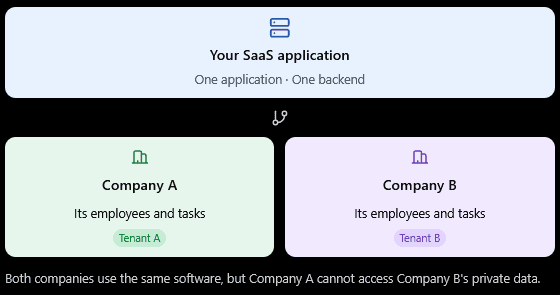
Customers share infrastructure, but they never share data or permissions. That separation is logical. Your code and database rules enforce it, which is exactly why a single missing filter can turn into a breach.
One distinction trips up a lot of beginners. The SaaS business model is how you earn money: monthly or yearly subscriptions. SaaS architecture is how you build, deploy, secure, and scale the product. The architecture has to cover tenant isolation, authentication, backups, availability, and billing, not just a frontend and a database.
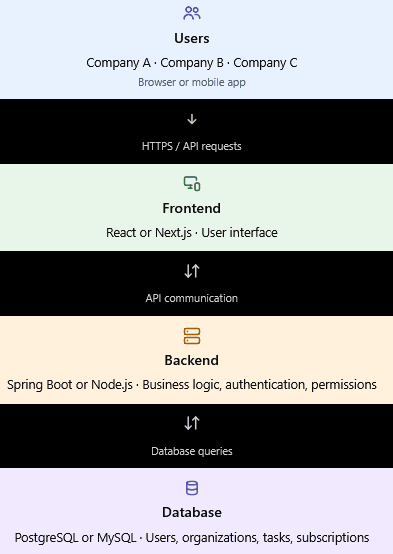
A typical request is simple. The user creates a task in the frontend, the frontend calls the backend API, the backend checks identity and permissions, saves the task, and the frontend shows the result. Production apps add payments, email, file storage, and monitoring around that core loop.
What Are the Best Multi-Tenant Data Isolation Strategies?#
For most early-stage products, the best multi-tenant data isolation strategy is shared tables with a tenant_id column, backed by database-level protection such as PostgreSQL Row-Level Security (RLS). It keeps infrastructure costs low and gives you a path to stronger isolation later.
There are three common models:
| Model | How it works | Isolation | Cost and complexity |
|---|---|---|---|
| Shared database, shared tables | All tenants use the same tables; tenant_id marks each row | Logical only, so it needs strict discipline | Lowest cost, simplest to run |
| Shared database, separate schemas | Each tenant gets its own schema | Stronger separation | Schema migrations multiply per tenant |
| Separate database per tenant | Each tenant gets its own database | Strongest | Highest cost, most operational work |
Shared tables win early because you run one schema and one migration path. Here's what the data looks like in a tasks table:
| id | tenant_id | task_name |
|---|---|---|
| 1 | TENANT_A | Build website |
| 2 | TENANT_A | Fix login |
| 3 | TENANT_B | Prepare report |
| 4 | TENANT_B | Send invoice |
When Company A logs in, the backend retrieves only its records:
SELECT *
FROM tasks
WHERE tenant_id = 'TENANT_A';
The catch: that tenant ID must come from trusted authentication and authorization context, never from something the user typed or sent. If the client can pick the tenant, the client can pick someone else's.
Multi-Tenant vs Single-Tenant SaaS: Which Costs Less?#
Multi-tenant is usually cheaper to run, because customers share infrastructure and you maintain one deployment. Single-tenant gives each customer a dedicated application or environment, so your costs climb with every customer you sign.
| Multi-tenant | Single-tenant | |
|---|---|---|
| Application | Shared by all customers | Dedicated to one customer |
| Infrastructure | Usually shared | Usually dedicated |
| Cost | Usually lower per customer | Usually higher per customer |
| Maintenance | One shared system to run | Separate deployments to run |
| Data isolation | Enforced in code and database rules | Backed by infrastructure separation |
The savings are real, but they aren't free. You pay up front in isolation work, tenant-aware caching, and usage controls. Single-tenant costs creep in the other direction: every new customer is another deployment to patch, monitor, and back up.
A common middle path is to keep most customers on shared infrastructure and offer dedicated environments to enterprise accounts that need them and will pay for them. And neither model is secure by default. Both need solid access controls.
Is Microservices an Overkill for a SaaS MVP?#
Yes, for most MVPs. The fastest architecture pattern to launch a SaaS MVP is a modular monolith: one deployable application with clear internal boundaries (tenant, user, membership, task, billing) and no network calls between your own services.
Three styles come up in every architecture debate:
- Monolith. One application, built and deployed as a unit. Best for beginners, MVPs, and small products.
- Microservices. Independently deployable services for things like billing, users, and notifications. Worth it when scaling or team structure demands it, and it costs you real operational complexity.
- Serverless. Functions and managed services, with no traditional servers for you to run. Suits event-driven work and spiky demand.
They aren't mutually exclusive. Plenty of SaaS products run a modular monolith with a few serverless pieces bolted on.
When should you migrate from monolith to microservices? When you can point at a measured problem. One module needs to scale on its own. Separate teams keep blocking each other's releases. A component needs a different runtime or security boundary. Before that, microservices mostly add deployment pipelines, service-to-service auth, and distributed debugging. In a monolith vs microservices cost comparison for an early-stage startup, the gap shows up less in hosting bills than in engineering hours.
How Do You Build a Multi-Tenant Database?#
Design the schema before you write any code. A task-management SaaS needs five core tables:
tenants: customer organizations (tenant_idPK, name, status, created_at)users: user accounts (user_idPK, email, password_hash, created_at)memberships: links users to organizations (tenant_idFK,user_idFK, role)tasks: tenant-owned business data (task_idPK,tenant_idFK, title, status, created_by)subscriptions: plans and billing (subscription_idPK,tenant_idFK, plan, status, current_period_end)
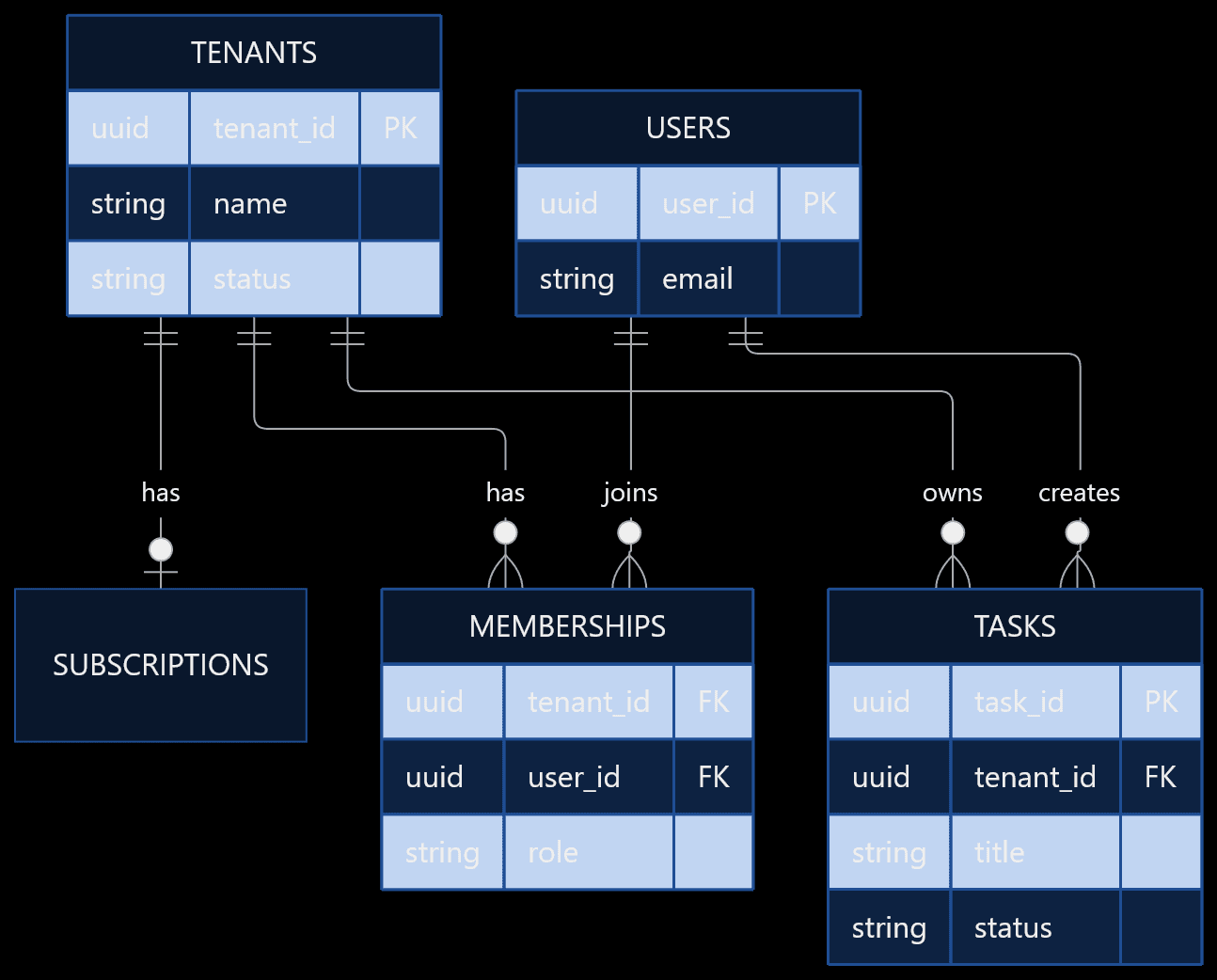
Why a memberships table? Because one person can belong to several organizations. A consultant might work with two companies on the same account. Memberships decide which organizations that person can access and what role they hold in each. It's also where OWNER, ADMIN, and MEMBER live.
Use foreign keys, unique constraints, and indexes. On tenant-owned tables, consider composite constraints like (tenant_id, task_id) so relationships can't accidentally cross tenant boundaries. And lead your composite indexes with tenant_id, since nearly every query filters on it.
How Should Authentication and Authorization Work in a Multi-Tenant App?#
Authenticate the user, resolve which tenant they're acting in, verify their membership, authorize the action, and only then touch the database. This flow is the most important part of the whole architecture.
- Log in. Verify credentials or an identity-provider login.
- Identify the user. Validate the session or access token.
- Resolve tenant membership. Confirm the user belongs to the requested organization.
- Authorize the action. Check role, permissions, tenant status, and resource ownership.
- Read or modify data. Run tenant-scoped database operations.
A request might look like this:
GET /api/tasks
Authorization: Bearer <access-token>
The backend validates the token, works out which organization the user is authorized for, and returns only that organization's tasks. If users can switch organizations, add an organization selector in the frontend, and make the backend validate the selection against current membership every time.
Never treat a tenant_id sent by the browser as proof of access. Authentication tells you who the user is. Authorization and tenant isolation decide what they can see. OWASP recommends enforcing tenant isolation across database queries, caches, file storage, and other resource layers.
How Do You Implement Tenant Isolation in Spring Boot?#
Centralize tenant resolution and authorization in one place, instead of hand-writing slightly different security checks in every controller. That's the single biggest win in a Spring Boot multi-tenant codebase. A layout that supports it:
src/main/java/com/example/saas/
├── config/        SecurityConfig, TenantConfig
├── security/      AuthenticationService, TenantAuthorizationService
├── tenant/        Tenant, TenantRepository, TenantService
├── user/
├── membership/
├── task/          Task, TaskRepository, TaskService, TaskController
└── billing/
The repository should only expose tenant-scoped queries. A simplified Spring Data example:
public interface TaskRepository
        extends JpaRepository<Task, UUID> {

    List<Task> findAllByTenantId(UUID tenantId);

    Optional<Task> findByTenantIdAndId(
        UUID tenantId,
        UUID id
    );
}
The service takes the tenant ID from the server-side security context, not from the request body:
public List<Task> getTasks(UUID authorizedTenantId) {
    return taskRepository.findAllByTenantId(
        authorizedTenantId
    );
}
Treat this as a starting point, not a finished security model. The controller or service has to guarantee that authorizedTenantId comes from a verified identity and membership check, and every read, update, and delete must enforce the same boundary.
On PostgreSQL, Row-Level Security adds a second safeguard at the database level. If you combine it with connection pooling, set the tenant context transaction-locally, and make sure the application's database role can't bypass the policies.
How Do You Prevent the Noisy Neighbor Effect in SaaS?#
Put a limit on every shared resource a single tenant can consume: API requests, database connections, query time, background jobs, and storage. The noisy neighbor effect happens when one tenant's heavy usage slows everyone else down, and it's the most common operational problem in shared-infrastructure SaaS.
What works in practice:
- Per-tenant rate limits at the API layer, tied to the customer's plan.
- Query guardrails: statement timeouts, pagination caps, and limits on export size.
- Fair background queues, with a per-tenant concurrency cap so one giant bulk import doesn't starve everyone else's jobs.
- Tenant-tagged metrics and logs, so you can see who is causing a slowdown instead of guessing.
- Dedicated infrastructure for the few tenants who outgrow shared capacity.
The same controls stop a single customer's runaway usage from degrading service and, as a bonus, they give you natural hooks for usage-based pricing.
What Are the Common SaaS Database Sharding Patterns for Multi-Tenant Apps?#
The usual pattern is to shard by tenant: every row belonging to a tenant lives on the same shard, and a lookup table maps each tenant to its shard. Queries stay on one shard, so you avoid cross-shard joins, and you can move a large tenant to its own shard without touching anyone else.
You probably don't need this yet. A single well-indexed relational database, with caching and read replicas, covers a lot of ground before sharding becomes necessary. But the decision you make on day one is what keeps the option open: if every tenant-owned table already carries tenant_id, sharding later is a data-movement project, not a rewrite. Tools like Citus for PostgreSQL and Vitess for MySQL exist for this stage.
How Should You Handle Billing and Subscriptions in a Multi-Tenant SaaS?#
Attach subscriptions to the tenant organization, not to an individual user. Customers who pay monthly or annually are paying for the whole workspace, and plan limits apply to everyone in it.
| Feature | Free plan | Pro plan |
|---|---|---|
| Team members | 3 | 25 |
| Projects | 2 | Unlimited |
| File storage | 100 MB | 10 GB |
| Reports | Basic | Advanced |
Your backend should check plan entitlements whenever a customer tries to use a restricted feature. A safe billing flow looks like this:
- The organization selects a plan.
- The backend creates a checkout session with the payment provider.
- The provider processes the payment.
- A verified webhook updates the subscription status.
- The backend enforces the matching plan limits.
Don't grant a paid plan just because the browser landed on a success page. Verify payment events on the backend, and handle duplicate webhook deliveries safely. Providers do send them.
Where Else Does Tenant Isolation Need to Reach?#
Everywhere customer data is stored or processed, not just in database tables. Most real-world leaks happen in the places people forget.
| Area | What to enforce |
|---|---|
| Database | Filter tenant-owned records and enforce access policies |
| API | Validate identity, membership, permissions, and ownership |
| Cache | Include tenant context in tenant-specific cache keys |
| File storage | Scope file access and object permissions to authorized tenants |
| Background jobs | Carry verified tenant context and recheck authorization where needed |
| Logs | Record tenant context without exposing sensitive data |
| Backups | Test tenant-specific recovery without exposing other customers' data |
Add rate limits, audit logs, secure password handling, secrets management, monitoring, and a documented data-retention policy on top. Together they cut the odds of a cross-tenant leak and keep one customer's heavy usage from hurting the rest.
How Do You Scale a Multi-Tenant SaaS Architecture?#
Build the modular monolith first, then add infrastructure when measured demand calls for it. You don't need microservices on day one.
- Stage 1, MVP. One frontend, one backend, one relational database, shared tenant-aware tables, and basic authentication.
- Stage 2, growth. Add caching, background jobs, monitoring, proper indexing, backups, and per-tenant usage limits.
- Stage 3, larger scale. Consider read replicas, dedicated infrastructure for selected tenants, separate services, sharding, or stronger database isolation, once measured demand and customer requirements justify it.
Which Tech Stack Should You Choose for a Scalable SaaS in 2026?#
For a bootstrapped or early-stage team, a cost-effective scalable tech stack is Next.js, Spring Boot, PostgreSQL, and a managed host, shipped as a single application first. You can swap any layer later, because the tenant model is what matters.
| Component | Role | Options |
|---|---|---|
| Frontend | What users see and use | React, Next.js |
| Backend | Business logic and API | Spring Boot, Node.js |
| Database | Application data | PostgreSQL, MySQL |
| Authentication | Login and identity | Auth.js, OAuth |
| Payments | Subscriptions and billing | Stripe, Razorpay |
| Hosting | Runs the app online | AWS, Azure, Vercel |
| File storage | Images and documents | Amazon S3, Cloudinary |
| Monitoring | Errors and performance | Sentry, OpenTelemetry |
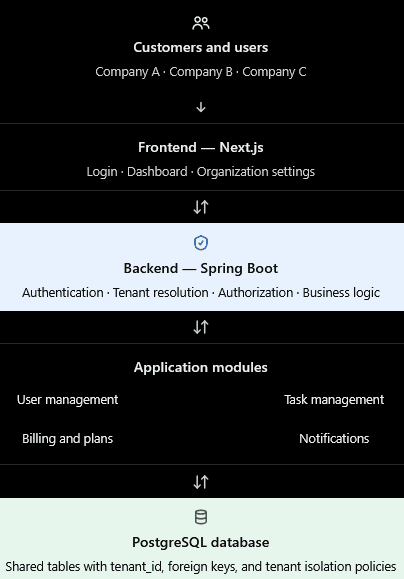
One note on the database. MySQL works fine for shared-table tenancy, but it has no native row-level security, so isolation rests entirely on your application code. If you want that second layer of protection, PostgreSQL is the better pick.
Choosing a stack for high-throughput SaaS? Pick the tools your team can actually operate and debug under pressure, then load-test early. A familiar stack you can tune beats a fashionable one you can't.
What Should You Build First? A 7-Step Roadmap#
Build in this order for your first Java full-stack SaaS:
- Project foundation. Spin up the Spring Boot app, PostgreSQL database, Next.js frontend, and dev configuration.
- Tenant and user model. Implement tenants, users, memberships, roles, and organization creation.
- Authentication. Add secure login, sessions or access tokens, and membership validation.
- Tenant-scoped CRUD. Build create, read, update, and delete with tenant isolation baked in.
- Security tests. Create two tenants and verify every endpoint denies cross-tenant access.
- Subscriptions. Add plans, verified payment webhooks, feature entitlements, and usage limits.
- Production readiness. Configure HTTPS, secrets, backups, migrations, logging, monitoring, and deployment.
If you're learning from scratch, the order is frontend, REST API, backend, database, authentication, multi-tenancy, payments, deployment. You can ship a useful SaaS without ever touching microservices.
Frequently Asked Questions#
What is the simplest way to implement multi-tenancy?#
Use one database with a tenant_id column on every tenant-owned table, and derive the tenant from the authenticated user's membership on each request. Add PostgreSQL Row-Level Security as a backstop if you can.
Should I use a separate database for each tenant?#
Not at the start. A database per tenant gives the strongest separation, but it multiplies cost and operational work. Reserve it for customers with strict compliance or performance requirements.
Can I use MySQL for a multi-tenant SaaS?#
Yes. Shared-table tenancy works on MySQL. You just won't have native row-level security, so every query has to be scoped in application code and covered by cross-tenant tests.
How do I test tenant isolation?#
Create two tenants with separate users and data. Then try to read, update, and delete Tenant B's records while authenticated as a Tenant A user, on every endpoint. Every attempt should fail.
When should I move from a modular monolith to microservices?#
When a specific module needs independent scaling, separate teams keep blocking each other's releases, or a component needs a different security boundary. Measure first, then split.
Further reading:
Share this article
Found this useful? Share it with others.